


Search Engine Optimization (SEO) can be confusing and complex, especially if you're new to it. Long-tail and short-tail keywords, anchor text and txt files, backlinking and link-building… it's enough to make your head spin.
And if you're creating digital products like courses, downloads, community, and coaching, chances are you're too busy creating valuable educational content to learn the ins and outs of Google's latest algorithm update.
The good news? There are a lot of easy-to-use free SEO tools out there that can do the heavy lifting (and algorithm analyzing) for you.
We’ve rounded up 11 simple SEO tools to help you optimize your website and get more eyes on your digital products. And as an added bonus, every tool on the list offers a free option.
We’ll cover:
- What SEO tools are and why you should use one
- Different types of SEO tools
- 11 best free SEO tools you can use to grow your business
If you’re looking for a place to build your SEO-optimized website and blog, Podia could be a great fit. Podia has your full site with unlimited landing pages and sales pages, as well as your community, digital products, online courses, and email marketing. Start your 14-day free trial today.
What are SEO tools? (And why should you use them?)
SEO tools give you ideas and suggestions on how you can make your website, products, and landing pages show up higher in the search engine results.
Here’s how it works. Optimized websites, blog posts, and sales pages show up higher in the search results for relevant keywords and phrases. The more you optimize your content, the easier it is for new people to find it through search.
And with Google sending more than 63% of all web traffic, showing up near the top of the results page matters. The first five organic results capture roughly two-thirds of all clicks, and with AI Overviews taking up more real estate on the first page of results, it’s more important than ever to be closer to the top.
Imagine that you sell online courses focused on teaching busy parents how to budget.
If I'm a busy parent with budgeting questions, I might Google a phrase like "budgeting for busy moms" or “easy budgeting for a family”.
When you have a piece of content, like a blog post, your online course sales page, or even your entire website, that’s optimized for that search term, you're more likely to show up on the first page of search engine results.
And if I click on your page, I'll discover your content, see that you have the expertise I'm looking for, and maybe even sign up for your course.
SEO tools can help you get that coveted top spot in the search results by showing you opportunities and areas where your work can be improved. Even if you don't have a dedicated marketing team (or any team at all), these tools can even the playing field for solopreneurs and small businesses to compete with big companies with bigger budgets.
There are a ton of free SEO tools out there, so you don't have to spend money to do SEO for digital products. With the right tools, you can DIY your SEO and start selling more digital products in no time.
(If you don't have a website to optimize, you can create one with Podia. Sign up for a free 14-day trial and start selling your digital products from your own site.)
Types of SEO tools
Some SEO tools are like Swiss army knives. They have several features and help with a wide variety of SEO tasks, while some are more focused on a specific piece of the SEO puzzle.
Here are some of the most common types of SEO tools.
Keyword research tools: These tools help you identify popular words and phrases people enter into search engines.
They also tell you:
- Keyword difficulty: How difficult it is for content to rank for a certain keyword
- Monthly search volume: How many times a keyword is searched in a month
This helps you figure out the ideal keywords you should be targeting.

Rank-tracking tools: Rank-tracking tools tell you how well your website ranks for your target keywords, so you can adjust your content accordingly.
Link-building tools: Link-building means earning backlinks (links to your website from other sites) to build your site’s authority in search engines, and it's a crucial piece of a successful SEO strategy.
Link-building tools can help you identify backlink opportunities and find out which websites link to yours.
Technical SEO tools: Technical SEO tools get into the nitty-gritty of SEO. On the backend of your site, technical SEO ensures that your web pages are structured for people and crawlers, the search engine robots responsible for indexing new and updated content.
Analytics tools: SEO reporting and analytics tools show you how your website is performing across a variety of metrics, including traffic, conversions, time spent on site, and many more.
Now, without further ado, let's get into our top SEO tools for creators.
11 of the best free SEO tools for creators
1. Google Search Console (GSC)

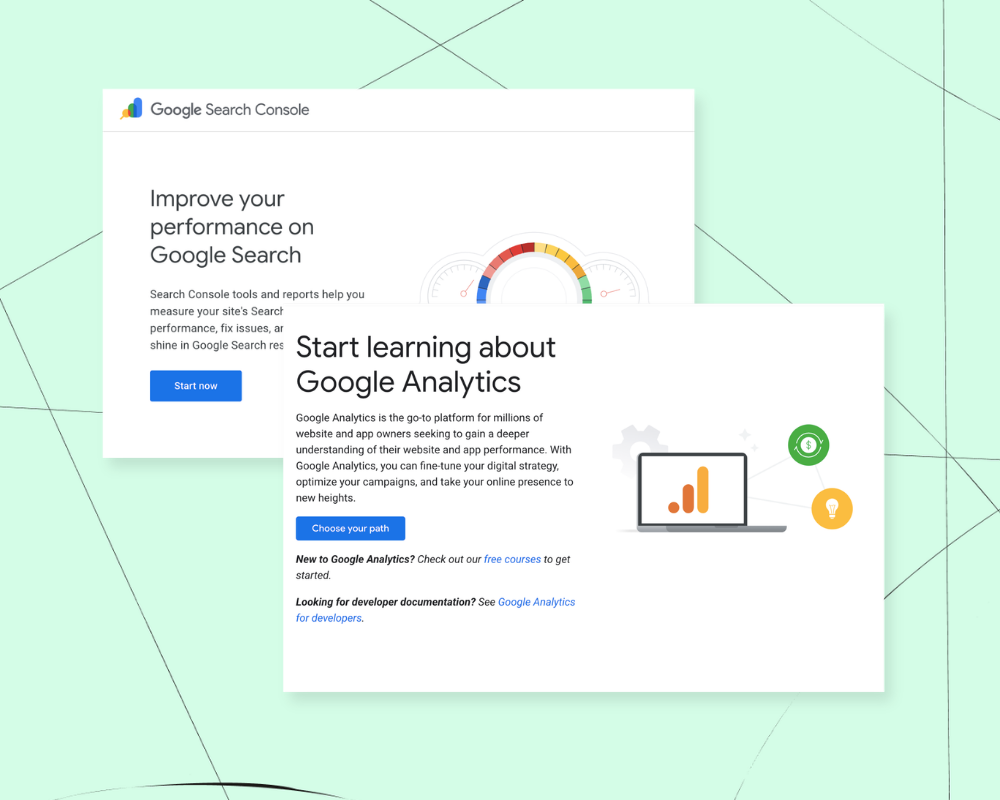
GSC is a free tool from the search experts at Google. GSC offers tools and reports that help you measure your website's traffic and performance, specifically in terms of how and where it shows up in Google searches.
Some of the main features of GSC include:
- Confirming that Google can find and crawl your site.
- Fixing indexing problems and requesting re-indexing of new or updated content.
- Viewing Google search traffic data for your site, including how often your site appears in Google searches, which search queries show your site, and how often searchers click through to your site from those queries.
- Receiving alerts when Google encounters indexing, spam, or other issues on your site.
- Showing you which sites link back to your website.
GSC can have a steep learning curve, but there are various resources available to help you navigate the platform. (If you search Google Search Console tutorials on YouTube, you’ll find tons of helpful options to get started).
If your audience also uses Bing to search, Bing Webmaster Tools is the (free) Bing equivalent of GSC.
2. Google Analytics (GA)

Google Analytics gives you all of the data you need to understand how customers interact with your website. To use it for SEO, add a Google Analytics tracking code to your website and connect it to GSC.
GA offers free reporting on SEO metrics like:
- Organic traffic (on mobile and desktop)
- Organic conversions
- Top landing pages
- Top exit pages (the last page that people visit before leaving your website)
- Bounce rate
- Time on site
- Pages per visit
One downside to GA is that, like GSC, its robustness leads to a steeper learning curve.
3. Google Keyword Planner

Google Keyword Planner is Google's keyword research tool.
This tool helps you find out which keywords people are searching in your niche. You can see monthly search volume and forecasted search volume, plus discover keyword ideas to help you reach your audience.
It's free for anyone with a Google account.
4. Ahrefs‘ free SEO tools

Though their paid plans start at $129/month, Ahrefs offers a variety of free SEO tools. On their free plan, you can access:
- Site Explorer: See what keywords you rank for already and what pages are bringing in the most traffic
- Site Audit: Fix technical SEO issues and make sure your site is healthy over time
- Web Analytics: See website views and analytics (basically an alternative to Google Analytics)
- Social Media Manager: Schedule social content and track analytics
- AI Content Helper: Tools to help your work show up in search engines and AI search results.
- SEO Toolbar: See how other websites rank when you visit them to learn more about your competition.
5. Moz’s free SEO tools

Like Ahrefs, Moz has a paid platform but also offers several free tools. Here are some of the best:
Domain Authority Checker: Enter a domain and see SEO metrics, including:
- Domain Authority, Moz's version of “Domain Ranking”
- Top pages based on “Page Authority,” Moz's algorithm of link metrics
- Estimated clicks for top keywords
- Recent new links to the domain
MozBar: A Chrome extension that shows you instant SEO metrics while viewing any webpage or search engine results page (SERP).
Keyword Explorer: Enter a keyword and get access to search volume, long-tail keywords, difficulty scores, and more suggestions.
Brand Authority Checker: Measure the strength of your brand to see how search engines interpret your content and site.
For full access to Moz's tools, Moz plans start at $99/month, but you can try a 30-day free trial before starting a paid plan.
6. Screaming Frog SEO Spider

Screaming Frog's SEO Spider is a website crawler, which means that it analyzes and audits both technical and on-page SEO issues.
A web crawler can help you find broken links, discover duplicate content on your site, and analyze your page titles and metadata to ensure that your SEO is working exactly as it should be on the front-end and back.
The free version of SEO Spider lets you crawl up to 500 URLs, which, unless your website has more than 500 pages, should be plenty. If you have a ton of content or run multiple sites, the paid version will set you back $279 per year.
7. GTmetrix

GTmetrix analyzes the loading speed of your web pages. If it finds that your site is slower than it should be, GTmetrix tells you what’s slowing your site down and offers actionable recommendations to make things load faster.
26.9% of ecommerce website visitors will wait less than four seconds for a page to load -- and 45.4% of visitors said they would be less likely to purchase something if the page load speeds were slower than expected.
Load time plays a role on the SEO side, too. According to the SEO experts at Moz, "Google has indicated site speed (and as a result, page speed) is one of the signals used by its algorithm to rank pages.”
The free version of GTmetrix lets users monitor one URL per day.
8. Google Page Speed Insights

Google Page Speed Insights gives you a quick look at how fast your website is running. You can plug in your website address and in a few minutes, you’ll get a look at several different scores for performance, accessibility, SEO, and best practices.
You can click into each score to get recommendations on where to improve, and this tool is free to use.
9. AlsoAsked

With AlsoAsked, you can find out exactly what people are searching for in your niche. You type in a keyword or phrase that you’re planning to target in your content, and you’ll get results for other words or phrases people searched for related to that topic.
This is helpful if you’re not sure what blog topics to cover, or if you just want to get more ideas for how to word your offers when talking to your audience. You can do a few free searches each day.
10. AnswerThePublic

Similar to AlsoAsked, AnswerThePublic is a tool that shows you questions people are asking around your specific niche. AnswerThePublic pulls in exact search queries from multiple platforms like Google, YouTube, and Amazon so you can see what kinds of things people really look for.
Once you have that information, you can use it to make your content plan and create resources that address the exact questions your people are already asking.
11. Talk to your audience
At the end of the day, there’s nothing more valuable than direct audience research. By spending some time talking to your audience, you can get valuable insights about what kinds of problems they’re facing, what questions they have related to your topic, and the language they use to describe what they’re going through.
Then, you can use all this information in your content and marketing to make sure you’re always answering the right questions.
To get this information, you can send an email to your email list, post on social media, or offer a bonus or giveaway in exchange for someone hopping on a short call with you. Remember to ask open ended questions about what your audience is looking for, what pain points they’re facing, and what goals they hope to achieve. This information is a goldmine as you plan your future products.
Get more eyes on your info products with these simple SEO tools
SEO is a great way to drive more organic traffic to your website and get your digital products in front of more potential customers. But search engine optimization can be a confusing and time-consuming process to handle on your own.
Luckily, there are tools available to help with almost every aspect of SEO, and all of them offer a free version.
To recap, here are 11 of the best free SEO tools for creators and small business owners:
- Google's free tools, including Keyword Planner for keyword research, Google Search Console and Google Analytics for in-depth data and reporting.
- Ahrefs' free webmaster tools, keyword generator, keyword rank checker, and backlink checker.
- Moz's free SEO tools, including their Domain SEO Analysis Tool, Mozbar Chrome extension, and Keyword Planner.
- Screaming Frog SEO Spider to audit your site for technical and on-page SEO issues.
- GTmetrix and Page Speed Insights to make sure your load time is as fast as can be.
- AnswerThePublic and AlsoAsked to see what kinds of questions potential customers are asking about your niche.
Good SEO can help you reach more people with your message and digital products, which can mean more impact and more money flowing into your business.
And if you’re looking for a place to build your online business, one where your products, email, website, and blog are all interconnected, give Podia a try. You can try everything free for 14 days.


