


When you’re on the hunt for an online course tool and a place to set up your online business, Kajabi and Teachable are two popular names that come up. In this guide, we’ll look at what each tool does well and where they fall short so you can make the right choice for you.
We're also going to talk about Podia as a third option throughout this comparison. Podia is an all-in-one tool for creators who want their courses, community, email marketing, and website connected in one place.
It’s a great option if you’re running into Kajabi's price tag or Teachable's plan limits, and I’ll call out places where it might be a better fit as we go.
Keep reading to learn:
- Kajabi vs. Teachable pricing
- What Kajabi and Teachable each do well
- Where both tools have gaps, and how Podia could be a better fit
- A detailed breakdown so you can make the right choice for your business
With projected 1.2bn people engaging in some form of online education by 2030 (Statista), there’s never been a better time to share what you know. You just need a tool to help you do it.
What changed for Kajabi and Teachable in 2025–2026
Both Kajabi and Teachable restructured their plans and pricing recently, and a lot of what you'll find in older comparison guides no longer applies.
Kajabi raised its prices in January of 2026, its first price increase in ten years. The Basic plan moved from $149/month to $179/month, there’s a limit of 5 products, and the contact limit on Basic dropped from 10,000 to 2,500.
Teachable removed its free plan in 2025 and replaced its old lineup with four paid tiers: Starter, Builder, and Growth. The entry-level Starter plan now comes with a 7.5% transaction fee and limits you to 5 products.
The result: both tools now cost beginners more, just in different ways. Teachable has a fee on every sale, while Kajabi charges a higher fixed price from day one.
Kajabi vs. Teachable pricing
With that in mind, here’s a closer look at how Teachable and Kajabi’s plans and pricing compare today. (Pricing verified September 2026.)
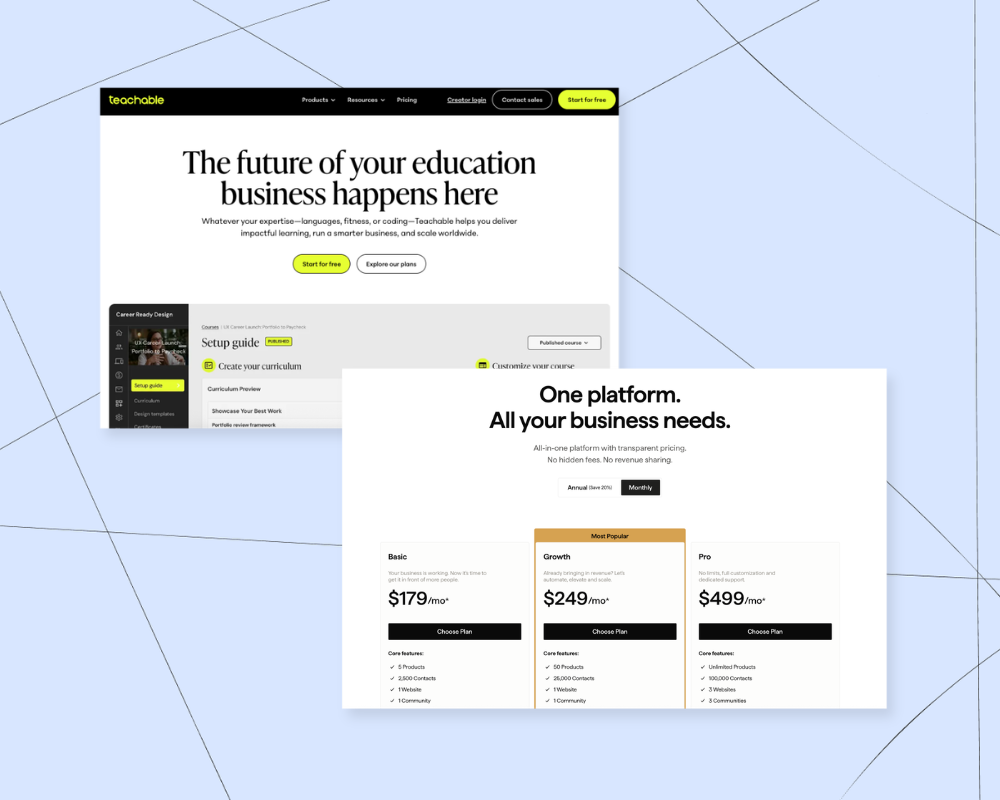
Kajabi has three plans and a 14-day free trial. There are no transaction fees when using Kajabi Payments. If you use a third-party payment processor, fees apply (percentage varies by plan).
- Basic: $179/month ($143/month billed annually). Includes 5 products, 2,500 contacts, 1 website, 1 community, 2 admin seats.
- Growth: $249/month ($199/month billed annually). Includes 50 products, 25,000 contacts, 1 website, 1 community, 11 admin seats, plus affiliate features, 500 AI credits, and the ability to remove Kajabi branding.
- Pro: $499/month ($399/month billed annually). Unlimited products, 100,000 contacts, 3 websites, 3 communities, 26 admin seats, a branded mobile app, and 1,000 AI credits.
To get started with Kajabi and create your first few courses and products, you’ll pay $179 a month. Everything’s included in that price, which is nice, but the question is whether you need to spend $2,100 a year just to sell your first course.
Teachable has three plans and a 7-day free trial.
- Starter: $39/month ($29/month billed annually) with a 7.5% transaction fee. Includes 5 products, 100 students, course certificates, upsells, and cart recovery.
- Builder: $89/month ($69/month billed annually) with a 0% transaction fee. Includes 10 products, 1,000 students, affiliates, real-time support.
- Growth: $189/month ($139/month billed annually) with a 0% transaction fee. Includes 50 products, 5,000 students, 5 admin seats, and the option to remove Teachable branding.
Even though Teachable’s prices are lower than Kajabi’s, Teachable limits both the number of products you can make and the number of free students you can enroll on every plan. If you're building a growing library or expecting your courses to reach a lot of people, those caps could be a problem in the future.
Let's see how this plays out by the numbers.
Say you're earning $1,000 a month in your online business. Here's what you'd actually pay at the entry-level plan for each tool:
- Kajabi Basic ($179/mo): $179 for the plan, no transaction fees with Kajabi Payments. That leaves you with $821.
- Teachable Starter ($39/mo): $39 for the plan plus $75 in transaction fees (7.5%), so $114 total. That leaves you with $886.
At this revenue level, Kajabi costs more each month, but that could swing in the opposite direction as your income grows because of Teachable’s transaction fees.
For some additional context, here's how Podia compares:
Podia has three pricing plans: Mover, Shaker, and Earthquaker. All plans include your website, community, courses, digital products, and unlimited students.
There's a free 14-day trial and free migrations are included on all paid plans so the team can move your products and customers over from wherever you're coming from.
- Mover: $49/month ($42/month billed annually), with a 5% transaction fee. Includes 50 products, storage for 500 videos, 25 community spaces, and email marketing for up to 100 subscribers.
- Shaker: $99/month ($84/month billed annually) with 0% transaction fee. Includes 150 products, 1,000 videos, 100 community spaces, affiliates, upsells, and email marketing for up to 500 subscribers.
- Earthquaker: $179/month ($150/month billed annually), 0% transaction fee. Includes unlimited products, unlimited community spaces, unlimited assistant seats, unlimited video storage, email marketing for up to 1,000 subscribers.
(With Podia Email, you can pay to add on more email subscribers any time as your list grows.)
Back to that $1,000/month example:
- Podia Mover ($49/mo): $49 for the plan plus $50 in transaction fees (5%), so $99 total.
- Teachable Starter ($39/mo): $39 + $75 in fees = $114 total.
- Kajabi Basic ($179/mo): $179
At this income level, Podia Mover is the most cost-effective of the three. And while Kajabi and Teachable limit you to just 5 products on their lowest tier plan, Podia Mover has room for 50.
What does Kajabi do well?
Kajabi is an all-in-one option with courses, coaching, communities, email marketing, sales funnels, landing pages, and your website. Your products, email sequences, sales pages, and course delivery all connect without any extra setup.
If you want your students to take their learning on the road, Kajabi offers mobile access for members, with branded mobile app features available on the highest-tier Pro plan. And if you’re interested in using AI in your business, Kajabi also has AI credits that allow you to use their built in AI features. These credits are included on the Growth and Pro plans.
For creators who want lots of advanced tools and have the budget to support it, Kajabi can be good option because all your features are in one place. But you really want to make sure you’re using each feature to the fullest, or else you could be paying for way more than you need.
Kajabi will also be a better fit if you have fewer, higher-ticket products because of the product and customer limits on the first two plans. But they do have the option to get unlimited products on the Pro plan, so you’re not stuck as your business grows.
What does Teachable do well?
Teachable is mainly focused on online courses, but it also has some marketing features built in to grow your business. You can sell courses, downloads, and coaching, and AI course creation tools are available on all plans to help you outline and draft content faster.
In terms of growing your business, Teachable gives you a website and sales pages for your products, and you can add upsells and cart recovery to your products. You can unlock affiliate marketing on the Builder plan and up. You can also send email broadcasts on the Builder plan and above, but for more advanced email marketing you’ll likely need to connect with an external tool.
In the past, Teachable had a community feature, but it has been placed into maintenance mode at the time we’re writing this article. This means the community feature is no longer being actively developed, so if community is part of your vision, you'll need a separate tool, which means another subscription and another connection to manage.
Where do both tools leave a gap?
Kajabi is a pricey option when you’re first starting out, and the Basic plan has some big limitations in terms of how many products you can sell (5) and how many contacts you can have in your business (2,500).
You might hit that ceiling sooner than you think, and trying to fit all your ideas into just 5 products is a challenge, unless you’ve already got a proven idea that sells well.
Teachable has a lower monthly rate to start, but the transaction fees, product limits, and caps on how many free students you can enroll make it harder to grow without constantly upgrading. With just 5 products, you’ll likely outgrow that faster than you think.
(Every Teachable plan gives you unlimited paying students and includes 100 free students (people who join without buying, through free products, manual enrollment, or imports). Above that, Teachable charges $0.50/month per free student.)
Once you start building somewhere, it’s a pain to have to move everything over to a new tool. That’s why we recommend picking something that not only has what you need to get started, but also has the features and space you’ll need in the future, so you can put down roots and spend more time on what you teach, not managing your tech.
With Podia, your online courses, community, email marketing, website, and blog all work together from one place. Your members get a home feed that brings together their courses, community spaces, and upcoming events. Your email tool knows what people have bought and how they've interacted with you.
There are no student limits on any plan, and you can reach unlimited products on the Earthquaker plan. (Which is almost the same price as Kajabi’s Basic plan, and Teachable’s Growth plan, both of which have product and customer limits.)
You can sell self-paced and cohort courses bundled with community, run group coaching programs, host virtual summits, and build free resource libraries, all from Podia.
“Before Podia, I had a hodgepodge of platforms, apps, and software duct-taped together. It was expensive, clunky, and it slowed me down. I looked at Kajabi, but it was several times more expensive and packed with features I didn’t need. Podia helped me move with speed again. It’s become my full-time income.”
If that fuller picture sounds like where you're headed, you can try Podia free for 14 days to see if it’s the right fit.
Comparing the details
How do communities work with Kajabi, Teachable, and Podia?
Kajabi includes one community on Basic and Growth, and three on Pro. Teachable's community feature is in maintenance mode and is no longer being actively updated. To make a community while using Teachable, you'll need a third-party tool.
Podia's community is connected to everything. Your members see their courses, community spaces, and events together in one home feed. You can sell standalone community memberships, bundle community access with courses, create subscription resource libraries, or all of the above.
What’s better for selling courses: Kajabi, Teachable, or Podia?
All three options have solid course builders with video hosting, drip content, quizzes, and payment plans.
Kajabi adds assessments with branching logic and more structured compliance features, which suits professional training or certification programs. Cohort courses are available on the Growth plan and above, which starts at $249/month.
Teachable has a drag and drop course builder with AI features to help you make your course content. There’s a mobile app so students can find their courses on the go.
Podia lets you build self-paced, drip, and cohort courses on all plans, and bundle them with community access or other products. Course completion certificates are included, and there are no student limits.
Do Kajabi and Teachable have email marketing tools?
Kajabi includes email marketing on all plans, with automations, sequences, and broadcasts. Contact limits apply by plan (2,500 on Basic, 25,000 on Growth, 100,000 on Pro).
Teachable's email tools are available on Builder and above, but they're mainly built for communicating with existing students. For list growth, segmentation, and automated campaigns, you may want a separate tool.
Podia includes full email marketing on all plans: automations, newsletters, broadcasts, segmentation, tagging, lead magnets, and opt-in forms. Because everything is connected, your email tool knows what your subscribers have bought and which campaigns drove revenue.
Mover comes with 100 subscribers, Shaker comes with 500, and Earthquaker comes with 1,000. You can add more subscribers any time from your billing page as your list grows.
What’s the best fit for you?
Kajabi is worth it if you're running an established business at a revenue level where $179/month is a comfortable operating cost, and you want one tool that handles courses, funnels, email, and community together.
Teachable makes sense if you want the lowest possible starting cost and you're selling a small number of courses. It's a good course-first tool, but you’ll need separate tools for your community and full email setup.
Podia is a strong fit if you want courses, community, email marketing, and a website all working together for an affordable price tag. There are no student limits on any plan, free migrations are included, and you can try everything free for 14 days.
If community is central to what you're building, or if you want to grow an email list and follower count alongside your courses and products, Podia was built for you.
Get started today and see what you can build.


