


You’ve launched your online business, and now it’s time to get the word out. The best way to get more eyes on your work is with an email list.
Email marketing is one of the most effective ways of growing your business because it gives you a 1:1 touchpoint with potential customers. Whether you have a list of 5 people or 50,000, you can use email to provide value, nurture your relationships, and let your people know whenever you launch products in the future.
But it might feel daunting to start an email list from scratch. In this article, I’ll share:
- Why email is one of the best investments you can make in your business
- The best platform for building your email list
- 5 steps to grow your email list, even if you’re starting from zero
If you’re still looking for a place to set up and grow your email list, Podia might fit the bill. Podia has your email list in the same place as your website, community, courses, and digital products, so everything you make is automatically connected. Start your 14-day free trial.
Why you need to build an email list
As a small business owner, you have a huge asset that enterprises can’t compete with: you.
It’s much easier for a customer to build a relationship with a human than a faceless organization. And it doesn’t get much more personal than an email newsletter — your voice and story land directly in your subscriber’s inbox.
You don’t have to compete with finicky social media algorithms or talk over the crowd on a platform full of competitors and sponsored content. You can share your words in a quiet space that you control.
The best news is that your email list doesn’t need to be huge to be impactful. Having a small number of subscribers who are all really interested in your online business is more valuable than having a massive list of random people — it’s better to have a small but mighty list than a huge list of uninterested subscribers.
But in order to find your people, you need somewhere to build your list, so that’s why step one is finding the right email marketing provider.
Step 1: Choose an email marketing provider
An email service provider is a tool that lets you grow your email list, send messages, and build automations and campaigns. There are lots of email marketing platforms on the market, and some of them are standalone tools that integrate with other platforms, while others have more features for building your full business.
You can check out our list of the best email marketing platforms to help you decide, but if you want an all-in-one email tool that’s already connected to your products and website, Podia could be a great fit.

Podia has your email list, email sign-up forms, newsletters, automated campaigns, and lead magnets built in. You can segment your audience and use tags and filters to message specific groups, and Podia automatically keeps track of data like your open rates, link clicks, and sales generated from each email.
You can also build a full website and blog, run a community, and create online courses, digital downloads, and coaching sessions for your buyers.

Get started today with a free 14-day trial.
Your choice of email service provider will be personal to you and your business. Whichever one you choose, make sure that it includes an email sign-up form, as this is essential for the next step.
Step 2: Capture emails on your site
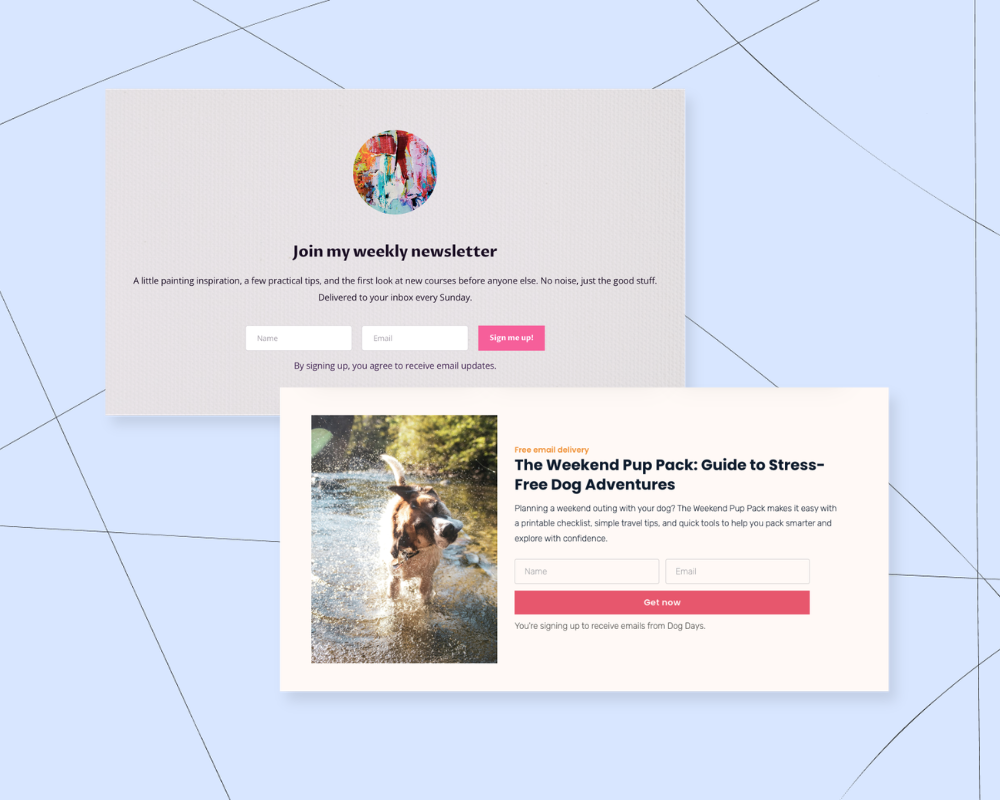
If you want to grow your mailing list, make subscribing easy. The easiest way to do this is to add an email sign-up form on your website. You can create a dedicated landing page where people can subscribe, or you can add a sign-up form to your home page, website footer, or blog posts.
Your email sign-up form is a section on your site that will collect email addresses.
- If you’re using Podia, this website section is already built into the site builder so you can add it in just a few clicks.
- If you’re using a different tool, you’ll often be provided with some HTML code you can paste into your website to create an email sign-up form.
When you add this section to your website, it’s important to help customers understand what they’re getting when they sign up. Instead of saying “join my newsletter,” explain what kinds of content, emails, or perks people will get when they join your list. Will you share helpful tips and resources? Will they get early access to new products? Let people know so they see a clear benefit to joining, right upfront.
For example, coaches and retreat hosts Leslie and Matt from LMNTL have this newsletter sign-up form on their website with a description that subscribers will get stories from the road, as well as updates about future retreats and events.

And career coach Angee Linsey from Dare to be Deliberate gets new people on her email list with this sign-up form in her website footer.

Ideally, you want to make it easy for your visitors to sign up for your newsletter wherever they end up on your website. Use email sign-up forms throughout your site with a clear description of why someone should join to increase your chances of conversions.
But you’ve also got another option if you want to sweeten the deal.
Step 3: Create lead magnets
A lead magnet is a piece of content, like an ebook, checklist, cheatsheet, or mini-tutorial, that you give away for free when someone signs up for your email list.
Your lead magnet idea doesn’t need to be super elaborate — something quick and easy that helps your ideal customer solve a problem, reach a goal, or learn something new works perfectly.
The most important thing is that your freebie should be related to whatever paid products you’re hoping to sell in the future. This is because the people you attract to your list today will be the same people you launch future products to.
If you hope to sell courses about gardening, a lead magnet about yoga poses won’t help you find the right people. But a checklist of gardening tools, or a short ebook about caring for houseplants, or a video care guide sure would!
For example, Michelle Parks from MP Virtual Assistance offers website courses, website building services, and virtual assistant packages for other business owners. She has a website launch checklist as her free lead magnet, which brings in new people who are working on a website and might need her services.

The key takeaways here:
- Lead magnets should be small and simple, think bite-sized wins.
- It should help your target customer get closer to a goal or overcome a pain point.
- It should be related to any paid products you sell so there’s a natural progression from freebie to paying customer.
Once you’ve got that, you’re ready to share your freebie far and wide.
Step 4: Share your lead magnet anywhere your ideal customers spend time
You’ve added an email sign-up form to your website and you’ve created a great free lead magnet to give people when they join your list. Now we’ve got to help more of the right people find you, and we’re going to do that by getting your freebie out into the world.
Here are a few tactics to try today:
- Share your lead magnet on social media. Give it a dedicated post but also link to it from your link in bio or video captions.
- Add it to your YouTube videos. If you have YouTube content related to your lead magnet, adding a link to your freebie in the caption is a great way to turn viewers into followers. (Bill Henry used this approach to grow his membership community without spending any money on ads. Read his creator story here.)
- Add your freebie to your email signature. This way anyone you contact can easily find your lead magnet and get on your list.
- Start blogging. Blogging gives you the opportunity to show up in search results for the topics you write about. You can add a lead magnet sign-up form to all of your blog posts so any readers who find your work can also join your list.
- Share your freebie in communities and forums where you participate. Are you active in any Facebook groups around your subject area? Are you in any communities with potential buyers? Share your free thing in these spaces too.
Whatever method you choose, what matters is that you don’t just share a link without context. Set the scene and make it relevant to your customers and their pain points.
Attracting subscribers is important but so is what happens next.
Step 5: Nurture your audience with a welcome sequence
Acquiring an audience is one thing; keeping them is another. That’s why I recommend using a welcome sequence to make your subscribers want to stay.
Welcome emails have an incredible 91.43% open rate, so they’re an opportunity to make a fantastic first impression.
You can schedule your welcome email to go out immediately after someone signs up for your email list, and if you like, you can add a series of emails that will automatically go out over the next few days. In these emails, you can:
- Introduce yourself and your business
- Set the tone (funny, serious, casual, professional)
- Set expectations by letting people know how often you’ll email them and what kind of content you’ll share
- Reward subscribers with discounts or bonus material
If you’re using Podia, you can set this up by going to the “Email” tab in your dashboard, clicking “Campaigns”, and clicking “New campaign”.
Set the entrance condition so the campaign starts when someone gets access to your lead magnet product or joins your audience, and then add your emails.

Your welcome series can be a tool to reassure your readers that they’ve made the right decision when they gave you their email address. They’re much more likely to stay and help your newsletter be the success it deserves to be.
Email list building made easy (or easier, anyway)
Starting from scratch with your email list is a fantastic opportunity to do things the right way. Instead of trying a thousand different tactics, concentrate on our five steps for a structured and mindful approach to the process.
The key steps are:
- Choose an email marketing platform that supports your needs.
- Make it easy for your visitor to sign up for your newsletter by adding sign-up forms to your website
- Create lead magnets that are valuable to your target audience
- Attract subscribers by sharing your lead magnet and newsletter on social media, your blog, and anywhere else your audience spends time online.
- Make your new customers feel appreciated by setting up a welcome email.
Building your newsletter is more of a marathon than a sprint, so focus on attracting quality readers, and your hard work will pay off.
And if you need a place to build your list, your website, your lead magnets, and your products, give Podia a try today. You can start free for 14 days.


