

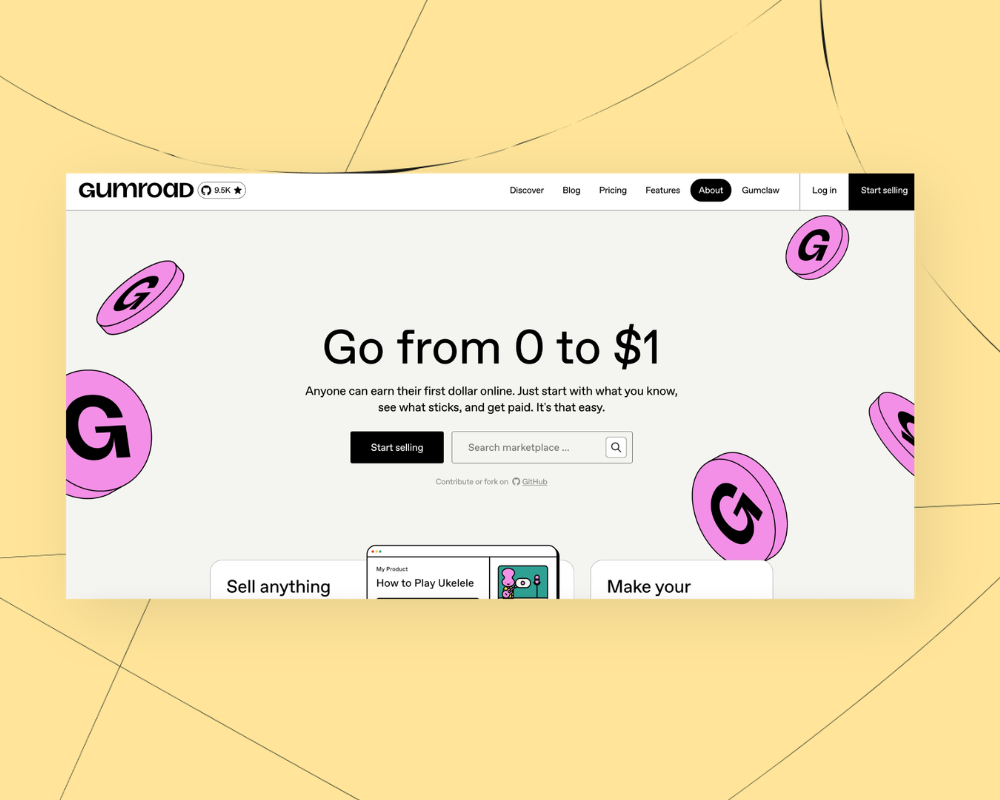

You've created a fabulous digital download that's perfect for your followers, but you need a place to sell it. In your research rabbit hole, you come across an option called Gumroad.
Gumroad is an online marketplace for selling digital downloads. Creators can sell videos, files, software, PDFs, ebooks, subscriptions, and memberships.
Getting started is simple, and there's no monthly fee, which makes Gumroad a popular first stop for creators who want to test their idea for free before investing in anything else. But Gumroad charges a high transaction fee on all sales, and a lot of creators find that they quickly end up spending more on a “free” platform than they would with fixed rate tool.
Goldman Sachs Research projects the creator economy will roughly double to $480 billion by 2027, and the platform you choose shapes how much of that growth you actually keep.
In this guide, we'll walk through Gumroad's strengths and limitations, then look at nine alternatives worth considering as your business grows.
In this guide, we’ll cover:
- Gumroad pros and cons
- 9 best alternatives to Gumroad, including pricing and features
- How to find the right fit for your business
Short on time? Podia is our pick for creators who want to sell courses, downloads, coaching, and memberships from one home base, without stitching together separate tools for each. Start your 14-day free trial to see it for yourself.
Gumroad pros and cons
Gumroad is a popular starter platform because there's no monthly fee, so you can list a product and start selling without paying anything upfront. You can build a basic storefront page, list as many products as you want, set up an affiliate program, offer discount codes, and generate software license keys. The platform handles checkout and file delivery well.
Gumroad is also a merchant of record, which means it collects and remits sales tax for you worldwide.
The tradeoffs show up as your business grows. Product pages are simple, with room for photos, a description, and file details, but there isn't a way to customize layout or build a full sales page or website.
Gumroad is also built primarily for digital downloads rather than courses or coaching. You can upload multiple video and text files into a listing to kind of make a course experience, but there's no dedicated course viewer, and coaching require workarounds.
Support is another consideration. There's a help center and a support email, but no live chat, which can mean longer waits when something urgent comes up.
But pricing is the real kicker. Sure, it’s nice to start for free, but you’ll pay 10% + $0.50 fee per transaction on any sales you bring in, forever.
On top of that, you’ll pay a 30% transaction fee on any sales that come through Gumroad's discover marketplace, where new customers find you through Gumroad's own search.
Ideally, you would have the option to upgrade and remove transaction fees as your business grows, but with Gumroad that's not possible.
Again, there’s no cookie-cutter mold for creator businesses, and there’s no one platform that works for everyone. If you determine that Gumroad isn’t the best fit for your needs, here are 9 Gumroad alternatives to try instead.
9 best alternatives to Gumroad
1. Podia

Podia is an all-in-one creator platform for selling digital downloads, online courses, coaching, events, memberships, and community. It comes with a sleek course builder, full website functionality, unlimited sales pages, and built-in email marketing features so you can communicate with your audience in one place.
Of the 15,000+ creators who use Podia, those selling digital downloads earn an average of $226 a month from them, and many choose to combine digital downloads with other products and packages to provide more value for customers.
Teach virtual trombone lessons. Create a course on how to knit matching outfits for you and your dog. No matter your passion, you can build, sell, market, and manage your entire creative business with Podia.

In addition to selling courses, digital downloads, and coaching sessions, you can also set up an affiliate program, create coupons, send email newsletters, build automated campaigns, and add upsells at checkout.
We even handle lead magnet delivery, and you can grow your email list by offering free resources directly from your Podia website.
And did we mention that your Podia website and sales pages will look really pretty?
According to Podia creator and Flex Lessons founder Joseph D’Amico, “Podia makes website building so fun. I feel like I could set up a site in an afternoon, and it would look great. And there’s something to be said for how pretty it is. It’s the best-looking one by far.”

Podia is also known for having friendly customer support through chat and email. If you get stuck at any point, we’re only a few clicks away.
Podia features:
- Sell digital downloads, courses, coaching, communities, memberships, and subscriptions
- Unlimited students
- Give customers several payment options like subscriptions, one-time-payments, and payment plans
- Offer virtual and in-person events and webinars
- Complete website and blogging functionality
- Make beautiful landing pages to promote your products
- Premium course features like quizzes, drip content, live cohorts, locked lessons, and course completion certificates
- Payment gateway integrations with PayPal and Stripe
- Sell in your local currency and manage sales tax (including VAT) automatically
- Integrations with Facebook Pixel, Pinterest Tag, and Google Analytics
- 1:1 Chats and DMs
- Email marketing tools
- Affiliate management
- Mover: $49/month or $42/month when paid annually (5% transaction fee)
- Shaker: $99/month or $84/month when paid annually (no transaction fee)
- Earthquaker: $179/month or $150/month when paid annually (no transaction fee)
Learn more about how Podia compares to Gumroad.
Get your free 14-day trial from Podia now to see these features in action.
2. SendOwl

SendOwl is a checkout platform designed for creators who sell digital products and services from their own websites. SendOwl takes care of payment processing, checkout, and file delivery so you can focus on making your thing.
Because SendOwl handles everything that goes on behind the scenes, you can easily transform your existing online presence into a storefront by adding an embedded checkout button. You can also generate links to specific products to share on social media.
SendOwl supports a wide range of product types, including ebooks, music, video, templates, courses, photos, printables, and memberships, and pricing is flat rather than a percentage of sales, so you keep what you earn.
SendOwl features:
- Customizable shopping cart
- Sell memberships and subscriptions
- Generate license keys
- Drip content
- Embeddable checkout
- Offer coupons and discounts
- One-click upsells
- Cart abandonment
- Affiliate marketing
- PDF stamping and expiring download links for piracy protection
SendOwl pros: You can customize the checkout process and sell through payment links, your own website, Shopify integrations, or SendOwl's API. Pricing is flat with no transaction fees, so a bigger month doesn't mean a bigger cut taken out.
People can buy gift purchases for others, and you can also use SendOwl to collect donations from supporters on a recurring basis.
SendOwl cons: While you can create product cards and checkout links, you can't build a storefront, website, or detailed landing pages with SendOwl. Plans are also capped by order volume and annual sales, so a big launch could mean an unplanned upgrade.
SendOwl pricing:
- Launch: $39/month ($32.50/month annually), up to 5,000 orders and $10,000 in annual sales, 10GB bandwidth
- Grow: $87/month ($72.50/month annually), up to 25,000 orders and $36,000 in annual sales, 20GB bandwidth
- Scale: $159/month ($132.50/month annually), up to 50,000 orders and $100,000 in annual sales, 50GB bandwidth
- Business: starting at $299/month for higher volumes
3. Sellfy

Sellfy is an ecommerce storefront software where you can run your own online shop and sell digital products, physical products, print-on-demand items, streaming, and subscriptions.
You can sell directly from Sellfy or embed purchase buttons and product cards on your own website. Create a customized shopping experience for your customers with upsells, discount codes, email marketing, shopping cart features, and cart abandonment.
Sellfy features:
- Build an online store or sell from your own page
- Sell digital, physical, streaming, or subscription products
- Print-on-demand products
- Email marketing
- Abandoned cart features
- Discounts and coupons
- Upsells
- Affiliate marketing
Sellfy pros: Sellfy doesn't charge any transaction fees on any plan. The platform has built-in print-on-demand functionality, making it easy for creators to sell a combination of digital downloads and physical products. You'll also get 24/7 email support on all plans, and every plan now includes unlimited products, digital products, physical products, subscriptions, and print-on-demand from the start.
Sellfy cons: This platform was not built for selling courses, so there isn't a dedicated course viewer. There's no community feature either, so you’ll need to connect and pay for another tool to get those features.
Cart abandonment, product upselling, and affiliate marketing are only available on the Business plan and above, so creators on Starter will need to upgrade to access them. Each plan also caps your annual sales volume rather than charging a percentage, so outgrowing a tier means upgrading regardless of your transaction fees.
Sellfy pricing:
- Starter: $39/month ($29/month annual), up to $10k in annual sales, 10GB max file size
- Business: $79/month ($59/month annual), up to $50k in annual sales, 15GB max file size
- Premium: $159/month ($119/month annual), up to $200k in annual sales, 20GB max file size
4. Payhip

Payhip can be used to sell online courses, coaching, memberships, and digital downloads like ebooks, software, and videos. Like Gumroad, Payhip users get a simple storefront and a product listing page for each item they sell.
Unlike Gumroad, Payhip comes with a dedicated course builder. You can add different media types like videos, text, quizzes, and drip content, and you can customize your course style to match your branding.
Creators can also sell memberships on Payhip. Add different tiers and include custom content with each plan, and offer free trials to let customers explore before they buy.
Payhip also supports coaching, with direct integrations for Calendly and Zoom so you can schedule sessions and video calls without leaving the platform. You can even offer physical products alongside your digital downloads.
Payhip features:
- Sell diverse file types
- Instant payouts
- Built-in affiliate features
- Software license keys
- Embeddable buy buttons
- Pay-what-you-want pricing
- Coaching tools with Calendly and Zoom integration
- Automatic VAT and sales tax collection
Payhip pros: Payhip has low transaction fees and a simple pricing structure. All plans come with full features, so nothing is gated behind a higher tier. Creators can choose what transaction fees and monthly payments they're comfortable with, and Payhip handles VAT and sales tax collection automatically.
Payhip cons: Payhip doesn't offer blogging or website building features beyond its store builder. By default, product listings have a simple layout. If you want to create in-depth sales pages or a full website to showcase your work, you'll need additional tools.
Payhip also lacks built-in email marketing, so if you want to send newsletters and run automations, you’ll need to connect and pay for a separate email platform.
Payhip pricing:
- Free: 5% transaction fee
- Plus: $29/month + 2% transaction fee
- Pro: $99/month, no transaction fee
All plans include unlimited products and unlimited revenue, and all features are available regardless of plan.
5. SamCart

SamCart has shifted in 2026, and now they’re marketing themselves as an AI-powered checkout platform build around conversion. Creators can sell courses, coaching, digital downloads, memberships, and physical products, and the platform now includes an AI assistant that helps write sales copy, build pages, and design digital products like ebooks and slide decks.
SamCart's main feature is checkout. It's built to increase what each customer spends through order bumps, one-click upsells, and post-purchase upgrades, plus recovery tools like cart abandonment emails.
SamCart features:
- Unlimited products, courses, memberships, and pages
- AI tools for page building, sales copy, and product design
- One-click upsells and order bumps
- Cart abandonment recovery
- Subscription payment recovery
- A/B testing
- Affiliate center
SamCart pros: SamCart's checkout is built specifically to raise average order value, with order bumps, upsells, and upgrades included in the buying flow.
If you’re a fan of using AI in your work, the AI assistant can help generate sales pages, product copy, and even full digital products like ebooks, which can save time if you're building from scratch. The affiliate center is available on both plans, so you can let other people promote your products too.
SamCart cons: There's no built-in community feature, so if you want to create a space for your customers to connect, you'll need a separate tool. SamCart also isn’t a full website builder, so you’ll likely need another tool to build out your online presence.
As far as features, AI usage and video hosting are limited on the Core plan. If you use SamPay, there’s a 2.9% + 30¢ transaction fee on top of the monthly cost, and you can only connect 3rd party payment processors on the Pro plan.
SamCart pricing:
- Core: $79/month
- Pro: $199/month
Both plans have a 2.9% + 30¢ transaction fee.
6. Etsy
Etsy is a virtual marketplace where people sell their handmade creations. Creators can sell unique physical goods like crafts, furniture, textiles, and jewelry, as well as digital goods like templates, graphics, presets, and printables.
Customize your storefront and use Etsy tags and categories to organize your work. Customers can leave reviews of your products as social proof, and Etsy displays how many sales you’ve made alongside your average rating.
Etsy features:
- Create a storefront for selling physical and digital items
- Product listings with multiple images
- Unlimited products
- Social sharing features
- Shoppers can “like” items and place them in their cart
- Customers can leave reviews and star ratings
- Built-in Etsy search and SEO features
Etsy pros: Etsy is good for discoverability. Because it’s a well-known platform, customers may find your work while casually browsing or searching for the items you sell.
Setting up your page and listing your first product is easy. Etsy is a household name, and hundreds of third-party videos, tutorials, and courses are available to help you optimize your shop and avoid common pitfalls.
Etsy cons: Etsy does not work for selling courses, memberships, or services. You don’t get a website of your own, nor do you get email addresses for your customers so you can’t stay in touch with them long term.
Sellers also have to pay a small listing fee of $0.20 per item, which could add up if you have many products available.
While Etsy’s popularity is great for getting your work out there, some niches can become oversaturated. Creators might be tempted to lower their prices to stay competitive, which can seriously dent your bottom line.
Etsy pricing:
- $0.20 per listing + 6.5% transaction fee
7. Shopify

Shopify is a powerful ecommerce platform built primarily for selling physical products, dropshipping, and running a full storefront. There are millions of active users, and it's one of the most popular platforms for physical goods.
That said, it’s possible to sell digital products too by connecting the free Shopify Digital Products app, which lets you attach files or links to any product, set access limits, and send download links to customers automatically after purchase.
Shopify has an app store with thousands of apps to make your store function how you like. Beyond digital products, there are membership apps and course apps to give you extra features, though many come with an added cost. You can also build your full website and run email marketing with Shopify, but you’ll pay for each piece as you add it on.
Shopify features:
- Sell physical or digital products
- Email and customer chat tools
- Full website builder with themes and domains
- AI assistant for store content, insights, and tasks
- Embeddable buy buttons and checkout
- Marketing automations and analytics
- Point of sale for in-person selling
Shopify pros: Shopify offers several plans and price points, so you can start small and scale up as you grow. There are lots of different branches of Shopify, so you can customize the platform to fit almost any kind of business and since it’s pretty well known, there are lots of add-ons and apps you can connect to make things work exactly the way you want.
Shopify cons: For just selling digital products, Shopify is probably more than what you need. It’s built to power physical products and point of sale, with digital products being more of an afterthought or add-on option.
Shopify also charges a transaction fee when you use a third-party payment provider instead of Shopify Payments.
Shopify pricing:
- Basic: $25/month ($22/month annual), 2% fee for third-party payment providers
- Grow: $65/month ($58/month annual), 1% fee for third-party payment providers
- Advanced: $399/month ($359/month annual), 0.6% fee for third-party payment providers
- Plus: starting at $2,300/month, 0.2% fee for third-party payment providers
8. Easy Digital Downloads

Easy Digital Downloads (EDD) is a WordPress plugin built specifically for selling digital products, like ebooks, PDFs, and software to licenses. Unlike general-purpose ecommerce plugins, EDD is built for selling digital downloads, with automated file delivery, licensing, and the option to charge subscription pricing.
Because it's a WordPress plugin rather than a hosted platform, you'll need your own WordPress site to run it. Once installed, EDD handles the technical side of digital sales, but you’ll need to maintain your website and hosting independently.
Easy Digital Downloads features:
- Unlimited products with no transaction fees
- Full checkout and cart
- Subscriptions and free trials
- Custom discount codes
- Abandoned cart recovery
- Software licensing and API (higher tiers)
Easy Digital Downloads pros: EDD doesn’t charge any transaction fees beyond your payment processor's standard rates. It's purpose-built for digital products, which means features like license key generation, customer reviews, and product bundles work well right out of the box. The plugin also integrates with over 100 tools, so it fits into your existing WordPress setup without much friction.
Easy Digital Downloads cons: Since EDD is a plugin, not a platform, you're responsible for your own WordPress hosting, security, and setup. There's no built-in website builder, course viewer, or community feature, so if you want those, you'll need to add separate plugins or tools on top.
Easy Digital Downloads pricing:
- Personal: $199/year, 1 site
- Extended: $399/year, 1 site
- Professional: $599/year, 2 sites
- All Access: $999/year, 3 sites
Find the right Gumroad alternative for you
Here's a quick look at the best alternatives to Gumroad for different creator needs:
Gumroad competitors without transaction fees:
- Podia: No transaction fees on the Shaker and Earthquaker plans
- SendOwl: No fees to sell digital downloads from your own website
- Sellfy: No fees to sell physical and digital products
- Payhip: No transaction fees on the Pro pricing plan
- Easy Digital Downloads: No transaction fees to use the WordPress plugin
- Shopify: No transaction fees on some plans if you use Shopify Payments
Best Gumroad alternatives that integrate with WordPress:
- Easy Digital Downloads: A WordPress plugin built specifically for selling digital products
Best alternatives to Gumroad for selling physical products:
- Sellfy: Sell physical and digital items from your own site or a Sellfy storefront
- Shopify: Sell physical and digital goods from your Shopify website
- Etsy: Sell handmade items on a well-known marketplace
Best Gumroad alternative for creators who want an all-in-one solution: Podia
Podia has all the tools you need to run your online business in one place. You can create and sell your digital download in the same place you run your website, email list, community, and everything else, and everything plays nicely together out of the box. Plus, you only have to remember one password.
No matter what creative new idea you come up with next, we'll be here to make it happen. Get started today with a free 14-day trial.


